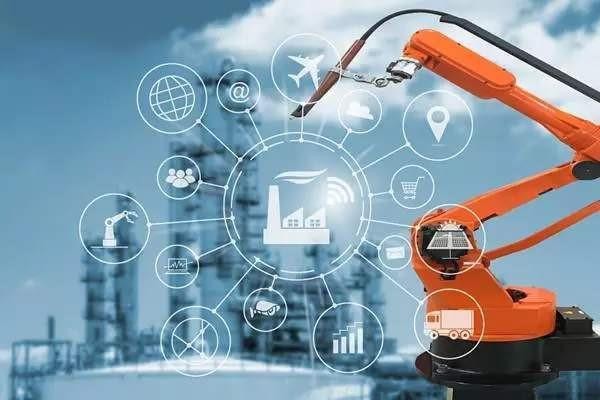
Industrial robots are widely used in the world. From the density of industrial robots, we can know the degree of automatic production in a country or region. The density of industrial robots can be used as an indicator to judge the difference of manufacturing automation degree in different countries and regions. Asia's industrial robot density grew at a compound rate of 14% from 2012 to 2019, higher than the global industrial robot density growth rate of 10% and twice the growth rate of Europe and the Americas. In the data of industrial robot density in the manufacturing industry of countries and regions in 2019, Singapore (918 units / 10 million people), South Korea (855 units / 10 million people) and Japan (364 units / 10 million people) are the top three countries with a high density of industrial robots. China ranked 15th with 187 units per 10,000 people, with a compound growth rate of 49.89% from 2012 to 2019, much higher than the compound annual growth rate of Japan and South Korea (1% and 12%, respectively).
In 2020, 2.7 million industrial robots will be in operation globally, up 12 percent year on year; The cumulative output of industrial robots in 2020 was 237,000, up 26.81 percent year on year; In March 2021, the monthly output of China's industrial robots was 33,075 sets, with a year-on-year growth of 91.84% and a new monthly output high; From January to March 2021, the cumulative production of 78,714 units, a year-on-year growth of 127.2%, the demand for industrial robots continues to rise.
Wide range of downstream application industries, continue to drive demand
Industrial robots are widely used in China, serving 44 industry categories of the national economy. Industrial robots mainly serve the manufacturing industry; According to the subdivided application industries, the distribution of China's industrial robots in the downstream industries is basically the same as the global distribution, and the automobile, electronics and metal processing industries occupy the top three, accounting for 35.79%, 28.7% and 8.19%, respectively. In March 2021, the accumulative growth rate of the completed fixed asset investment in the domestic manufacturing industry was 29.8%, and the accumulative growth rate of the completed fixed asset investment in the computer, communication and other electronic equipment manufacturing industry was 40.4%. The high growth rate drove the average level of the industry.
In February 2021, after experiencing low and negative growth for about 3 years, the cumulative growth rate of fixed asset investment completed in the automobile manufacturing industry showed a positive growth rate above 10% for the first time, and the cumulative growth rate dropped to -3.3% in March.
Due to the rapid development of China's industrial robot industry and orderly production automation, the density of industrial robots in China will grow at a compound rate of about 20% in 2020-2023. It is expected that the density of industrial robots in China will reach 269 units per 10,000 people, 323 units per 10,000 people and 388 units per 10,000 people in 2021-2023. Domestic industrial robot market space is huge.
As industrial robot technology becomes more mature and operations become more refined, the utilization rate of industrial robots in packaging, sorting, distribution and other work in the long tail industries such as food and beverage will gradually increase.
Experiencing the impact of the epidemic, the advantages of automated production have been highlighted. In the downstream long tail industries, enterprises will increase their efforts to automate production, and "man-machine collaboration" will accelerate. Thus, the demand for midstream industrial robots will be boosted, and the upstream industrial robot industry chain will also benefit.