


The output voltage, current and power of monocrystalline (or polycrystalline) silicon solar cells are very small. Only when they are packaged in series and parallel into modules can they be used as power sources alone. Since the cell size has various fixed standards, direct series or parallel connection may not meet the needs of components, so it needs to be cut into smaller units before welding. The more advanced cutting method in the industry is to use a laser dicing machine.
Slicing is the first process of component processing, and its subsequent processes are as follows:
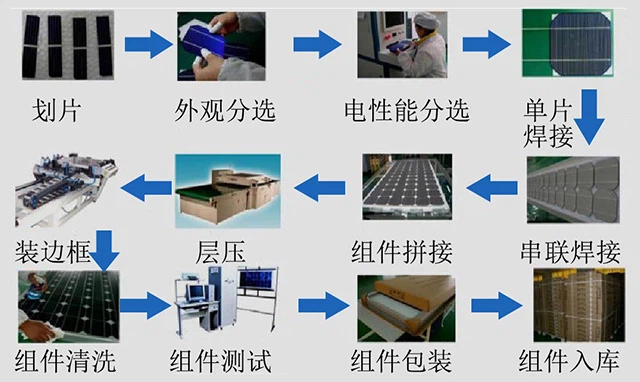
Adtech robots and vision systems are mainly used in the two processes of scribing and stringing in the above picture, providing customers with fast and accurate feeding solutions. Among them, the dicing machine has higher requirements on the accuracy of feeding speed. Taking the field application of a domestic manufacturer of laser processing equipment and complete sets of solar energy equipment as an example, Adtech provided SCARA robot and AVS one-to-two vision system for its laser dicing machine, realizing high-speed and high-precision double-station feeding, Meet the key indicators of 3000pcs/h, placement error + scribing accuracy <±0.15mm.
No.1
Project Overview
This set of equipment is suitable for dicing of monocrystalline silicon and polycrystalline silicon solar cells of any size, and can complete functions such as automatic feeding, automatic positioning, automatic laser scribing, automatic boxing, etc., with a high degree of automation; optional 1/3 slicing mechanism , to achieve 1/3 automatic dicing lobes. Robots and vision systems are located at the loading station.
In order to improve the processing efficiency, the dicing capacity should reach 3000pcs/h. Two conveyor belts are specially designed to feed the materials at the same time. After being positioned by the vision system, a SCARA will alternately grab the cells and place them on the dicing table quickly and accurately. Laser scribing. Placement error + scribing accuracy is within ±0.15mm. The vision system will also detect its chipping, missing corners, cracks, cell orientation, etc., and place the problematic incoming materials in waste boxes for processing and reuse.

No.2
Program composition
The reclaiming robot adopts Adtech AR3215 body
+QC400 drive and control integrated machine;
The vision system adopts Adtech AVS2300
One-to-two visual system,
With two 1000w pixel industrial cameras.
No.3
Project Scenarios and Highlights
The main difficulty of this project lies in high precision and high speed, which should be completed within 1.2S, visual positioning (defective product screening) → robot reclaiming → unloading to dicing table → return. Among them, the vacuum time of picking and placing material takes 0.3-0.4S. Since the battery is fragile, it needs to be handled with care during the picking and placing process. The robot is required to decelerate in a timely manner during the rapid movement of the robot, and the movement is fast and slow.
In terms of robots, the trajectory path is optimized, the process interaction IO signals are cached, and the multi-threading mechanism of the robot system is used to realize the left side taking pictures on the right side and the right side taking pictures on the left side. Delayed high tempo effect.
In terms of visual positioning, to achieve high-precision positioning under a large field of view of 200mm X 250mm, Adtech's unique automatic calibration algorithm is used, which not only simplifies the calibration process but also improves the calibration accuracy; in addition, the vision software adopts proportional scaling. , edge finding and corner finding and other functions to improve the accuracy and adapt to the switching of cells of different sizes. In terms of visual defect detection, a cell inspection module has been specially developed to detect cell defects.
