


Motion Control Card
ADTECH (SHENZHEN) TECHNOLOGY CO., LTD. was established in 2002. As the leader of domestic motion control solutions provider, ADTECH had been build up the motion control, motor drive, CNC control system application and industrial robots in total four major products. ADTECH products are widely used in industrial robots, printing and packaging, metal processing, light textile, home, electronic equipment, special machine tools and other fields, become the representative brand in the field of motion control industry application. Companies in key cities across the country set up a liaison office and service centers, and gradually establish a global sales and service network, products have been exported to Europe and the United States, the Middle East, Southeast Asia, Hong Kong and Taiwan, 111 countries and regions.
Why Choose Us?
Quality control
We have strict quality control measures to ensure the quality of products leaving the factory.
Advanced equipment
Our company had been build up the motion control, motor drive, CNC control system application and industrial robots in total four major products.
One-stop solution
12 months warranty, online technical service and agent local support.
Service support
CNC Programming Application System with completely independent intellectual property, Motion Control Solution and its supporting application software.
-
![Programmable Automation Controller SC30 STEP]() Programmable Automation Controller SC30 STEPSTEP maximum 64 axes Codesys programming controller plus four pulse axisread more
Programmable Automation Controller SC30 STEPSTEP maximum 64 axes Codesys programming controller plus four pulse axisread more -
![PCI BUS Motion Control Cards 2 To 32 Axes Multi-axis]() PCI BUS Motion Control Cards 2 To 32 Axes Multi-axismotion control cards 2 to 32 axes line interpolationread more
PCI BUS Motion Control Cards 2 To 32 Axes Multi-axismotion control cards 2 to 32 axes line interpolationread more -
![Multi-axis Motion Control Card ADT-8949C1/H1 Series]() Multi-axis Motion Control Card ADT-8949C1/H1 SeriesADT-89X9C1/H1 series are special designed for high performance industrial automation applications. can provide precise multi-axis motion control ,interpolation ,electronic camming ,electronic...read more
Multi-axis Motion Control Card ADT-8949C1/H1 SeriesADT-89X9C1/H1 series are special designed for high performance industrial automation applications. can provide precise multi-axis motion control ,interpolation ,electronic camming ,electronic...read more -
![High Performance Motion Control Card ADT-8949C1/H1 Series]() High Performance Motion Control Card ADT-8949C1/H1 SeriesADT-89X9C1/H1 series are special designed for high performance industrial automation applications. can provide precise multi-axis motion control ,interpolation ,electronic camming ,electronic...read more
High Performance Motion Control Card ADT-8949C1/H1 SeriesADT-89X9C1/H1 series are special designed for high performance industrial automation applications. can provide precise multi-axis motion control ,interpolation ,electronic camming ,electronic...read more -
![OM2 Servo Motor Sigriner Step]() OM2 Servo Motor Sigriner Stepstep Sigriner Ω6 servo motor single/three-phase 17bit 23bit incremental and absolute encoder with or without break low medium high inertia 220v 380vread more
OM2 Servo Motor Sigriner Stepstep Sigriner Ω6 servo motor single/three-phase 17bit 23bit incremental and absolute encoder with or without break low medium high inertia 220v 380vread more -
![ADT-6320E EherCat Bus Control Card]() ADT-6320E EherCat Bus Control CardADT6320E bus control card, support 16 axis bus control, 16 bus IO module expansion, servo support QXE, EM, Panasonic, Sanyo communication servo with EtherCAT protocol, with motion trajectory...read more
ADT-6320E EherCat Bus Control CardADT6320E bus control card, support 16 axis bus control, 16 bus IO module expansion, servo support QXE, EM, Panasonic, Sanyo communication servo with EtherCAT protocol, with motion trajectory...read more -
![ADT-6329E EherCat Bus Control Card]() ADT-6329E EherCat Bus Control CardADT6329E EtherCAT bus control card, supports up to 64 nodes, has the function of motion trajectory pre-processing planning, supports four groups of independent pre-processing interpolation...read more
ADT-6329E EherCat Bus Control CardADT6329E EtherCAT bus control card, supports up to 64 nodes, has the function of motion trajectory pre-processing planning, supports four groups of independent pre-processing interpolation...read more -
![High performance Four axis Pulse Motion Control Card]() High performance Four axis Pulse Motion Control CardThe ADT-8949C1/H1 multi-axis motion control card is a member of the high performance four-axis motion control card based on the computer PCI bus of Suntime. A system can support up to 10 control...read more
High performance Four axis Pulse Motion Control CardThe ADT-8949C1/H1 multi-axis motion control card is a member of the high performance four-axis motion control card based on the computer PCI bus of Suntime. A system can support up to 10 control...read more -
![High performance 8 axis Pulse Motion Control Card PCI]() High performance 8 axis Pulse Motion Control Card PCIADT-8989 C1H1 4/6/8/12 axis PCI bus motion control card based on A9 dual-core; Excellent speed control, trajectory control, high-speed IO control functions; Support PSO, RTCP, electronic CAM and...read more
High performance 8 axis Pulse Motion Control Card PCIADT-8989 C1H1 4/6/8/12 axis PCI bus motion control card based on A9 dual-core; Excellent speed control, trajectory control, high-speed IO control functions; Support PSO, RTCP, electronic CAM and...read more -
![Bus Type Motion Control Card]() Bus Type Motion Control CardADT6329E EtherCAT bus control card, supports up to 64 nodes, has the function of motion trajectory pre-processing planning, supports four groups of independent pre-processing interpolation...read more
Bus Type Motion Control CardADT6329E EtherCAT bus control card, supports up to 64 nodes, has the function of motion trajectory pre-processing planning, supports four groups of independent pre-processing interpolation...read more -
![Based On PCI-E Bus High-performance 4-axis Motion]() Based On PCI-E Bus High-performance 4-axis MotionADT-8941A1 high-performance 4-axis motion control cardread more
Based On PCI-E Bus High-performance 4-axis MotionADT-8941A1 high-performance 4-axis motion control cardread more -
![2 Axis Universal Type Motion Control Card For Cnc]() 2 Axis Universal Type Motion Control Card For CncADT-8920A1 universal motion control card is one of the ADTECH axis motion control card PCI bus computer-based members.read more
2 Axis Universal Type Motion Control Card For CncADT-8920A1 universal motion control card is one of the ADTECH axis motion control card PCI bus computer-based members.read more


What Is Motion Control Card?
In one configuration, the motion card can be housed in box with I/O and networking connections and mounted directly to the machine or process it controls. Control programs can be uploaded to the cards via USB link or Flash drives.
Benefits of Motion Control Card
Multifunction
Motion card with Multiple programmable output interfaces, it can be configured as controlled peripherals such as water cooling and fog cooling. Bringing you a comfortable and convenient experience.
Good practicality
Excellent speed control, trajectory control, high-speed IO control functions; Support PSO, RTCP, electronic CAM and other functions.
Superior performance
Adopts aluminum alloy enclosure, DCDC electrical isolation, Optocoupler isolation. It can control Multiple stepper motor running at the same time maximally.
Communication cycle short
250us-4ms.it indicates that this system has advantages of high precision, high performance and good economic in practical.
Real-time feedback
Motion controllers can provide real-time feedback on the performance of mechanical systems, allowing for quick diagnosis and correction of issues.
Automation
Motion controllers can automate the control of mechanical systems, reducing the need for manual control and increasing productivity and efficiency.
Types of Motion Control Card
In this architecture, the motion card connects to external amplifiers, which generally accept +/- 10V analog signal input, and control torque or sometimes velocity of the motor.
Also known as a smart amplifier. In this approach the controller is a "box," and is usually rack or rail mounted. The drive either plugs into the wall, or is fed with a DC bus voltage.
Combines the synchronization ability of multi-axis motion cards with the reduced wiring and increased robustness of standalone drives. Such a drive uses a network connection to communicate with a central host, but still has all the standard drive features of profile generation, amplification, and internal AC or DC power management.
The advantages of reduced wiring are combined with easy multi-axis synchronization by locating the amplifiers on the multi-axis card itself.
Components of Motion Control Card

Motion controller
Often referred to as the brain of the motion control system, the motion controller coordinates the motor drives; sometimes there are several drives being controlled at once. Based on the programmed target position and motion profiles, the motion controller creates the appropriate trajectories for the motors to follow. Like the human brain, it sends the command to accelerate to a precise speed and slow down to a stop at the desired location. The number of controllers used in an application will vary based upon the number of individual processes that require control. Each controller in a system will receive instructions from and send feedback to the computer or PLC that controls the machine or line.

Drive serves
The drive serves as the interpreter between the motion controller and the motor. Its function is to receive the command signal from the controller, interpret the command and then supply the proper level of power to the motor in order to provide accurate movement of the machine. Drives are available as digital, analog, linear, switching, stepper and servo drives. Each type of drive has different characteristics. Digital drives contain discrete input and output capabilities, while analog drives contain variable input and output capabilities. Linear drives are used for straight motion. Switching drives use a technique called pulse width modulation to turn voltage on and off rapidly to create a particular motion or speed. Stepper drives offer low- to mid-level torque and produce smooth rotation over a wide speed range. Servo drives interpret command signals and internal feedback loops to precisely control motion in high-power, high-speed applications.

Motor functions
The motor functions as the muscle. Its role is to receive the electrical input from the motor drive and convert it into motion. The two types of electric motors are AC and DC and they both transform electricity into motion by means of magnetic fields. DC motors run on Direct Current, while AC motors run on Alternating Current. The speed of DC motors is typically controlled by varying the amount of applied voltage. The speed of AC motors is typically controlled by varying the frequency of applied voltage. AC motors are more commonly used.

Feedback devices
Used only in closed-loop motion control systems, feedback devices provide motor position information to the motion controller so it can make adjustments to its commands at the appropriate times. Encoders, which measure and report position, velocity and direction, are the most popular feedback device. Closed-loop motion control systems can precisely perform complex motions that open-loop motion control systems can't.
Carefully consider controller location.
Just as in real estate, think location, location, location! Controller location in the overall motion system is the single most important factor that can simplify, or complicate, a motion design. To determine the correct location of the motion control software and motion controller itself, engineers should ask themselves three questions:
1.Are the axes' motions synchronized with each other?
2.What response time is required to handle system changes?
3.How important is code portability?
Software architecture matters.
When it comes to motion controllers, so many different options are available that the choices can seem overwhelming. Just remember what really matters — the software architecture that will be used to control the application. Writing software in the host (typically this means a PC) is usually the most convenient, but it is the least time-responsive. On the other hand, putting all the software in the motion controller will likely give the performance you want, but can mean extra work, particularly if you must learn a vendor-specific motion language. Motion controllers are typically long on raw software horsepower, but short on support for standard computer languages.
Organize your control problem.
Consider a C-language-based motion controller so that software can be run on the host or on the motion controller, making re-partitioning easier. Most importantly though, organize your control problem. Separate slower functions from high-speed functions, and make sure those high-speed functions reside in the motion controller. Data collection, display, and other data management functions can go in the PC.
Make sure your motion controller can handle worst-case scenarios.
Mechanics interacting with the motion controller can fail in some obvious ways, such as bearings becoming stiffer and servo parameters no longer working, but they can fail in subtle ways as well. Can your machine controller handle rare, worst case events, such as the simultaneous arrival of a motion command, index pulse, limit switch, and the end of a motion? Expect the worst to happen and with luck, it won't. Test early and often, under as wide a range of load conditions as possible, and design with margin.
Focus on relevant specifications.
A common mistake made by engineers is focusing on irrelevant specifications. For example, selecting the fastest sample rate is often unnecessary, as a 1 kHz sample rate is sufficient for all but the smallest high-performance motors. A better approach: Think about the processing time required to perform your specific application's program.
Don't overestimate determinism needs.
Engineers often overestimate the requirements for determinism in system communications. Communication uncertainties of less than 100 microseconds are fine for nearly all motion systems. Tighter determinism rarely has any effect on overall system performance.
Motion controllers aren't magicians.
Systems engineers often think that motion controllers can compensate for a poorly designed mechanical system. While motion controllers can overcome some weaknesses like non-linearity, they can't compensate for gross mechanical errors such as low-frequency resonances, undersized motors, mechanics with large dead bands, and spring-like couplings.
Avoid common grounding.
A common mistake that engineers make is to have a common ground and supplies on both sides of the optoisolators. If it's the same ground, it isn't isolated. The filtering effect engineers think they are getting from isolation is really the low-pass effect due to the slowness of the opto.
Choose the right motion controller for the job.
Specifying the wrong type of motion control is a common issue. However, picking the right tool for the job can save both initial costs and engineering time. For example, many single-axis applications can be performed using the on-board motion control available in the digital drive. The same is true of simple point-topoint multi-axis motion. Using the on-board motion can save a lot of money and programming complexity, because you can use a less powerful PLC as opposed to a PLC with built-in motion.
Know the warning signs of impending failure.
Typically, performance issues occur at higher speeds or higher axis counts. When using intelligent digital drives, this issue goes away, as the drives each carry their own position loop, thereby reducing the load on the main motion processor.
Our Factory
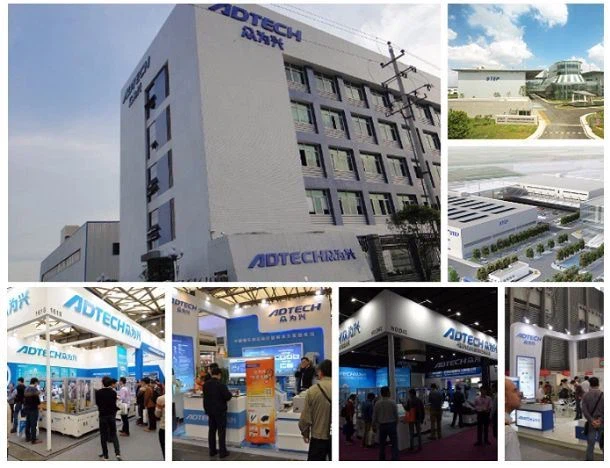
The factory is an associated company ADTECH (SHENZHEN) TECHNOLOGY CO.,LTD, located in Building B3, Pujing Guangmimng High-Tech Park, Guangming New District, Shenzhen. It occupy 7,560 square meter, has 144 employee. We have our own brand. Also accept ODM&OEM. Meanwhile, We have strict quality control measures to ensure the quality of products leaving the factory.
FAQ
Q: What is a motion card?
Q: What is a motion control controller?
Q: What is motion control method?
Q: What are the different types of motion controllers?
Q: What are the benefits of motion control?
Q: Where is motion control used?
Q: What is the difference between a driver and a motion controller?
Q: Which device is used to control motion?
Q: What are the three basic types of controllers?
Q: What is an external motion controller?
Q: What are the four modes of a controller?
Q: How does motion activated work?
Q: What is compliant motion control?
Q: What are the examples of motion control system?
Q: Where is motion control used?
Q: How do motion controllers work?
Q: Does Steam support motion controls?
Q: Why proportional control is not enough?
Q: What does a proportional controller leads to?
Q: What is motion control in games?
As one of the most professional motion control card manufacturers and suppliers in China, we're featured by quality products and good service. Please rest assured to buy customized motion control card at competitive price from our factory.