


Servo Driver
ADTECH (SHENZHEN) TECHNOLOGY CO., LTD. was established in 2002. As the leader of domestic motion control solutions provider, ADTECH had been build up the motion control, motor drive, CNC control system application and industrial robots in total four major products. ADTECH products are widely used in industrial robots, printing and packaging, metal processing, light textile, home, electronic equipment, special machine tools and other fields, become the representative brand in the field of motion control industry application. Companies in key cities across the country set up a liaison office and service centers, and gradually establish a global sales and service network, products have been exported to Europe and the United States, the Middle East, Southeast Asia, Hong Kong and Taiwan, 111 countries and regions.
Why Choose Us?
Quality control
We have strict quality control measures to ensure the quality of products leaving the factory.
Advanced equipment
Our company had been build up the motion control, motor drive, CNC control system application and industrial robots in total four major products.
One-stop solution
12 months warranty, online technical service and agent local support.
Service support
CNC Programming Application System with completely independent intellectual property, Motion Control Solution and its supporting application software.
-
![SIGRINER Ω6-C Servo Driver]() SIGRINER Ω6-C Servo DriverBased on the Ω platform to create a localization of highly cost-effective servo products, inherited the excellent genes of Ω6-A servo, streamline some functions, close to domestic use habitsread more
SIGRINER Ω6-C Servo DriverBased on the Ω platform to create a localization of highly cost-effective servo products, inherited the excellent genes of Ω6-A servo, streamline some functions, close to domestic use habitsread more -
![New Series Servo Driver]() New Series Servo DriverΩs-AP2 series servo drive can cover the power of 0.1kW~2kW servo motor; Pulse control (differential channel - tell pulse 4M, optocoupler channel -500K); Analog speed and torque control; Internal...read more
New Series Servo DriverΩs-AP2 series servo drive can cover the power of 0.1kW~2kW servo motor; Pulse control (differential channel - tell pulse 4M, optocoupler channel -500K); Analog speed and torque control; Internal...read more -
![High-performance DDR Motor Servo Driver]() High-performance DDR Motor Servo DriverSTEP QXR series high-performance pulse type DDR motor servo driver, integrated with the current world's leading servo control technology, its excellent drive performance has reached the...read more
High-performance DDR Motor Servo DriverSTEP QXR series high-performance pulse type DDR motor servo driver, integrated with the current world's leading servo control technology, its excellent drive performance has reached the...read more -
![Ωs-AN1 Series Servo Driver]() Ωs-AN1 Series Servo DriverThe Ωs-AN1 series of servo drivers can cover the power of 0.2kW to 7.5kW servo motors. Support EtherCAT, CANOpen bus communication, communication rate of 100Mbps; Current loop frequency response...read more
Ωs-AN1 Series Servo DriverThe Ωs-AN1 series of servo drivers can cover the power of 0.2kW to 7.5kW servo motors. Support EtherCAT, CANOpen bus communication, communication rate of 100Mbps; Current loop frequency response...read more -
![42/60/90 Integrated All in one Servo]() 42/60/90 Integrated All in one ServoThe innovative driver, encoder and motor are highly integrated, with pulse control, CAN bus control, MODBUS and other control methods, greatly reducing the installation space, easy installation,...read more
42/60/90 Integrated All in one ServoThe innovative driver, encoder and motor are highly integrated, with pulse control, CAN bus control, MODBUS and other control methods, greatly reducing the installation space, easy installation,...read more -
![Ωm-N1 Series Servo Driver]() Ωm-N1 Series Servo DriverThe Ωm-N1 series of servo drives is a multi-axis product from Sigriner, consisting of a rectifier unit (AC200V), a three-axis integrated drive unit and a four-axis integrated drive unit (DC300V)....read more
Ωm-N1 Series Servo DriverThe Ωm-N1 series of servo drives is a multi-axis product from Sigriner, consisting of a rectifier unit (AC200V), a three-axis integrated drive unit and a four-axis integrated drive unit (DC300V)....read more -
![EM-C Series Network Servo Drivers]() EM-C Series Network Servo DriversEM-C series servo drives not only have good control performance but also have international standard servo safety functions. It can be used in many fields such as robot, semiconductor, metal...read more
EM-C Series Network Servo DriversEM-C series servo drives not only have good control performance but also have international standard servo safety functions. It can be used in many fields such as robot, semiconductor, metal...read more -
![Sigriner Ω6-P Servo Driver step]() Sigriner Ω6-P Servo Driver stepBased on the Ω platform to create a localized and cost-effective servo product, inherited the excellent genes of Ω6-A servo, simplify some functions, can be customized according to user needsread more
Sigriner Ω6-P Servo Driver stepBased on the Ω platform to create a localized and cost-effective servo product, inherited the excellent genes of Ω6-A servo, simplify some functions, can be customized according to user needsread more -
![Sigriner Ω6-A Servo Driver]() Sigriner Ω6-A Servo DriverΩ6 series products carry the German core technology of drive control, integrate the Chinese factory intelligent manufacturing concept, to provide users with excellent drive control product...read more
Sigriner Ω6-A Servo DriverΩ6 series products carry the German core technology of drive control, integrate the Chinese factory intelligent manufacturing concept, to provide users with excellent drive control product...read more -
![Optocoupler Circuit Universal Pulse Type Servo Drive]() Optocoupler Circuit Universal Pulse Type Servo DrivesigrinerΩ series products carry the German drive control core technology, integrate the Chinese factory intelligent manufacturing concept, to provide users with excellent drive control product...read more
Optocoupler Circuit Universal Pulse Type Servo DrivesigrinerΩ series products carry the German drive control core technology, integrate the Chinese factory intelligent manufacturing concept, to provide users with excellent drive control product...read more -
![Universal Single Axis Pulse Type Servo Drive]() Universal Single Axis Pulse Type Servo DriveΩs-AP2 series servo drivers can cover the power of 0.1kW~2kW servo motors ♦ Pulse control (differential channel - tell pulse 4M, optocoupler channel -500K) ♦ Analog speed, torque control ♦...read more
Universal Single Axis Pulse Type Servo DriveΩs-AP2 series servo drivers can cover the power of 0.1kW~2kW servo motors ♦ Pulse control (differential channel - tell pulse 4M, optocoupler channel -500K) ♦ Analog speed, torque control ♦...read more -
![General Purpose Single Axis Bus Servo Drive]() General Purpose Single Axis Bus Servo DriveThe Ωs-EN1 series of servo drivers can cover the power of 2kW-22kW servo motors. The Ωs-EN1 series of servo drivers can cover the power of 2kW-22kW servo motors. Support EtherCAT bus...read more
General Purpose Single Axis Bus Servo DriveThe Ωs-EN1 series of servo drivers can cover the power of 2kW-22kW servo motors. The Ωs-EN1 series of servo drivers can cover the power of 2kW-22kW servo motors. Support EtherCAT bus...read more


What is Servo driver?
A servo drive is an electronic amplifier used to power electric servomechanisms.
A servo drive monitors the feedback signal from the servomechanism and continually adjusts for deviation from expected behavior.
Benefits of Servo driver
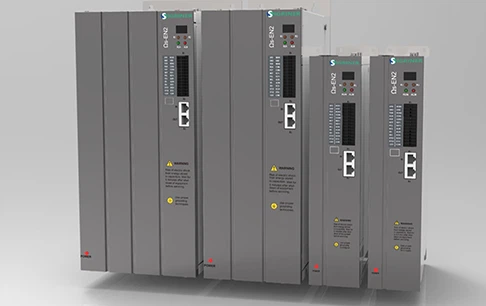
Support various motor and encoder drive systems
The main advantage of a Servo System compared to traditional DC or AC motors is the addition of motor feedback.This feedback can be used to detect unwanted motion, or to ensure the accuracy of the commanded motion. The feedback is generally provided by an encoder of some sort. Servo Motors can also act as a brake by shunting off generated electricity from the motor itself.

More reliability and precision
When compared to straight power amplifiers, Servo Drives offer a wide range of advantages for automatic machining systems, including superior positioning, speed, and motion control.
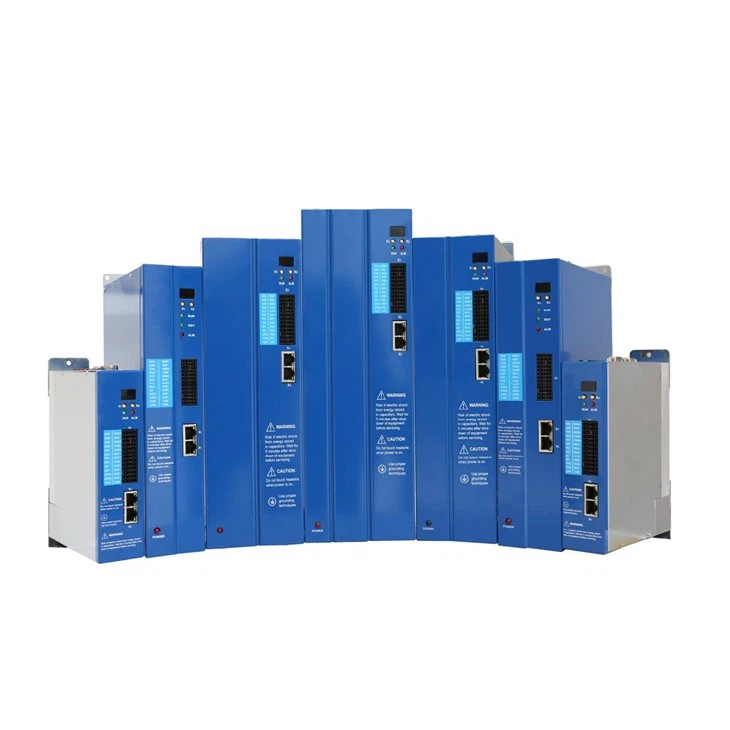
Adjust for differences
The Servo Drive for regulating the difference between actual motor status with requested motor status by making the necessary current or voltage adjustments.

Support position control mode
Whether it is just positioning a globe valve to the right position or aiming a telescope, a Servo Drive can regulate a shaft to its desired position regardless of friction or other disturbances.
Types of Servo Driver
AC servo drives
AC servo drives accomplish all of the tasks a traditional servo drive does, but they are specifically designed for AC motors, and provide the added advantage of motor feedback.
Use an AC servo drive to amplify your AC motor's desired velocity, torque, and position, as well as stiffness, damping, and adaptive feedback.
Stepper drives
Stepper drives provide simple and accurate control of position and speed by converting pulsed control signals from a PLC or other indexers/motion controllers into the appropriate voltage and current needed to drive a stepper motor. A common control method supported by stepper drives is step and direction control, where one signal determines when a motor rotation or "step" is to be performed and the other determines the direction of the motion. Stepper drives often employ advanced microstepping technology in order to smooth the motor motion and stepping response.
DC servo drives
Within DC motor control systems, servo drives amplify command signals and transmit electric currents to servo motors. They are integral to the effective production of motion with the ideal velocity, position, and/or torque for an application. DC servo drives constantly work to adapt performance based upon data received from a sensor within the servo motor. They ensure that each DC motor is able to constantly adapt to a wide variety of performance-related variables.
DC servo drives specifically provide for precise position and speed control within the closed loop systems of brushed or brushless DC motor control systems. These drives increase the motor's life cycle.
Application of Servo Driver
Servo drives are used for many applications. As they are built into wider devices they are found in many different industries.
Some application areas for servo drives include;
Aerospace
Marine
Aviation
Satellite Communication
Laboratory Automation
Arctic Drilling
Ground Mobile
Extreme Outdoor Operation
Some More Specific Applications
Robotics
Servo motors are used on the "joint" of a robot arm to monitor the angle and speed of movement.
Printing press
A servo motor can control the stop/start of the print heads themselves and the movement of the paper ensuring accurate printing.
Conveyor belts
In various manufacturing settings, servo drives are used to start and stop conveyor belts.
Metal cutting machines
The precise motion control that servo motors can provide make them perfect for various metal cutting and forming machines including lathes, milling, grinding, punching and pressing.
Camera focusing
Within many cameras there are very small servo motors that help with the auto focus function on the lenses.
Automatic Doors
This is a very common application as automatic doors are used widely in shops and hotels; servo motors control the movement of the door once the signal from personnel has been received.
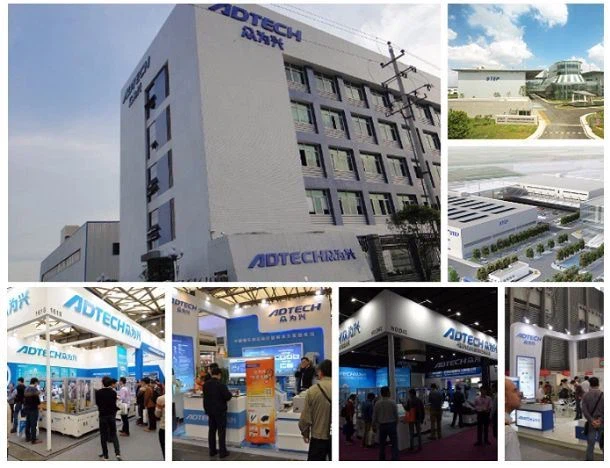
Our Factory
The factory is an associated company ADTECH (SHENZHEN) TECHNOLOGY CO.,LTD, located in Building B3, Pujing Guangmimng High-Tech Park, Guangming New District, Shenzhen. It occupy 7,560 square meter, has 144 employee. We have our own brand. Also accept ODM&OEM. Meanwhile, We have strict quality control measures to ensure the quality of products leaving the factory.
FAQ
Q: What does a servo driver do?
Q: What is the purpose of a servo?
Q: What does a servo driver board do?
This allows the user to have a direct interaction with the position, speed or direction of an attached motor, and is great for projects where you need to be able to directly control a servo's movements.
Q: What is the difference between a servo and a VFD?
Q: Is a servo drive a controller?
Q: How do you control a servo driver?
Q: Can any motor be used as a servo?
Q: Why do servo drives fail?
Q: What is the difference between a motor driver and a servo driver?
Q: What is the difference between servo and stepper driver?
Q: Why use a servo controller?
Q: What are the different types of servo drives?
Q: Can a servo drive be repaired?
Q: Do you need a servo driver?
Q: What are the advantages of servo drive?
The main advantage of a Servo System compared to traditional DC or AC motors is the addition of motor feedback. This feedback can be used to detect unwanted motion, or to ensure the accuracy of the commanded motion. The feedback is generally provided by an encoder of some sort.
Q: Are brushless servos better?
Q: How does a servo driver work?
Q: Is a servo the same as an actuator?
Q: What is the difference between servo drive and motion control?
Q: Do servos need a motor driver?
As one of the most professional servo driver manufacturers and suppliers in China, we're featured by quality products and good service. Please rest assured to buy customized servo driver at competitive price from our factory.