


Industrial Robot
ADTECH (SHENZHEN) TECHNOLOGY CO., LTD. was established in 2002. As the leader of domestic motion control solutions provider, ADTECH had been build up the motion control, motor drive, CNC control system application and industrial robots in total four major products. ADTECH products are widely used in industrial robots, printing and packaging, metal processing, light textile, home, electronic equipment, special machine tools and other fields, become the representative brand in the field of motion control industry application. Companies in key cities across the country set up a liaison office and service centers, and gradually establish a global sales and service network, products have been exported to Europe and the United States, the Middle East, Southeast Asia, Hong Kong and Taiwan, 111 countries and regions.
Why Choose Us?
Quality control
We have strict quality control measures to ensure the quality of products leaving the factory.
Advanced equipment
Our company had been build up the motion control, motor drive, CNC control system application and industrial robots in total four major products.
One-stop solution
12 months warranty, online technical service and agent local support.
Service support
CNC Programming Application System with completely independent intellectual property, Motion Control Solution and its supporting application software.
-
![STEP SR Serial Six-axis Industrial Robotic Arm]() STEP SR Serial Six-axis Industrial Robotic Armsix-axis SR serial Wrist Rated Payload 20-55 KG Max Working Radius 1718-2281MMread more
STEP SR Serial Six-axis Industrial Robotic Armsix-axis SR serial Wrist Rated Payload 20-55 KG Max Working Radius 1718-2281MMread more -
![6 axis Robot Control System SRC4 S and L model]() 6 axis Robot Control System SRC4 S and L modelQC620 High performance: Dynamic algorithm with intelligent optimal acceleration, the beat is increased by 5% on average, and the life of key components is extended by 10% on averageread more
6 axis Robot Control System SRC4 S and L modelQC620 High performance: Dynamic algorithm with intelligent optimal acceleration, the beat is increased by 5% on average, and the life of key components is extended by 10% on averageread more -
![New Robot Control Cabinet]() New Robot Control CabinetThe SRC2.7 series control system is available in a variety of specifications to meet the requirements of different load robots and different application environmentsread more
New Robot Control CabinetThe SRC2.7 series control system is available in a variety of specifications to meet the requirements of different load robots and different application environmentsread more -
![Robot Control Cabinet for 6 axis]() Robot Control Cabinet for 6 axisThe SRC2.7 series control system is available in a variety of specifications to meet the requirements of different load robots and different application environmentsread more
Robot Control Cabinet for 6 axisThe SRC2.7 series control system is available in a variety of specifications to meet the requirements of different load robots and different application environmentsread more -
![SRC2.7C Robot Control Cabinet]() SRC2.7C Robot Control CabinetSRC2.7 series control system has a variety of specifications to choose from, and can meet the requirements of different load robots and different application environments at the same time.read more
SRC2.7C Robot Control CabinetSRC2.7 series control system has a variety of specifications to choose from, and can meet the requirements of different load robots and different application environments at the same time.read more -
![SRC Fourth Generation Robot Control Cabinet]() SRC Fourth Generation Robot Control CabinetSRC4 control cabinet is a new drive and control integrated control cabinet, used with 6-axis robot, with compact and flexible, safe and reliable, easy to use, rich interconnection and other...read more
SRC Fourth Generation Robot Control CabinetSRC4 control cabinet is a new drive and control integrated control cabinet, used with 6-axis robot, with compact and flexible, safe and reliable, easy to use, rich interconnection and other...read more -
![Desktop Six-axis Industrial Robot]() Desktop Six-axis Industrial RobotSD desktop robot series: rich product line, load covering 3~8kg, arm span covering 500~919mm; High precision, repeatability up to plus or minus 0.02mm; High speed, standard gate track beat 0.45S;...read more
Desktop Six-axis Industrial RobotSD desktop robot series: rich product line, load covering 3~8kg, arm span covering 500~919mm; High precision, repeatability up to plus or minus 0.02mm; High speed, standard gate track beat 0.45S;...read more -
![Flexible Production Industrial Robot]() Flexible Production Industrial RobotSR series general industrial robot has a compact shape structure, each joint is installed with high-precision reducer, high-speed joint speed can carry out flexible operations in a small working...read more
Flexible Production Industrial RobotSR series general industrial robot has a compact shape structure, each joint is installed with high-precision reducer, high-speed joint speed can carry out flexible operations in a small working...read more -
![Build-in Cable Palletizing Robot]() Build-in Cable Palletizing RobotSP series handling palletizing industrial robot adopts 4-axis design, wrist load capacity is 120Kg, maximum working radius is 2403mm; It has the advantages of simple structure, easy operation, low...read more
Build-in Cable Palletizing RobotSP series handling palletizing industrial robot adopts 4-axis design, wrist load capacity is 120Kg, maximum working radius is 2403mm; It has the advantages of simple structure, easy operation, low...read more -
![Universal 6-axis Robot]() Universal 6-axis RobotThe SR series general-purpose industrial robots have a compact shape and each joint is fitted with a high-precision speed reducer. The high-speed joints enable flexible operation in a narrow...read more
Universal 6-axis RobotThe SR series general-purpose industrial robots have a compact shape and each joint is fitted with a high-precision speed reducer. The high-speed joints enable flexible operation in a narrow...read more -
![Maximum Throughput Palletising Robot With High Speed Performance]() Maximum Throughput Palletising Robot With High Speed Perf...SP series of handling and palletising industrial robots adopts 4-axis design, with a wrist load capacity of 120Kg and a maximum working radius of 2403mm; it has the advantages of streamlined...read more
Maximum Throughput Palletising Robot With High Speed Perf...SP series of handling and palletising industrial robots adopts 4-axis design, with a wrist load capacity of 120Kg and a maximum working radius of 2403mm; it has the advantages of streamlined...read more -
![Stabilisation And Improvement Of Welding Quality Welding Robot]() Stabilisation And Improvement Of Welding Quality Welding ...Compact, small and lightweight, SA series welding industrial robots are specialised arc welding robots that enable stable welding, obtaining high precision weld paths, shortening welding cycle...read more
Stabilisation And Improvement Of Welding Quality Welding ...Compact, small and lightweight, SA series welding industrial robots are specialised arc welding robots that enable stable welding, obtaining high precision weld paths, shortening welding cycle...read more


What is Industrial Robot?
An industrial robot is a robot system used for manufacturing. Industrial robots are automated, programmable and capable of movement on three or more axes.
Benefits of Industrial Robot
Increased efficiency
Industrial robots can work faster and more accurately than human workers, which can lead to increased productivity and efficiency.
Reduced labor costs
Industrial robots do not require breaks, vacation time, or benefits, which can lead to lower labor costs for companies.
Improved safety
Industrial robots can perform tasks that are dangerous for human workers, such as working with hazardous materials or in high-temperature environments.
Consistency
Industrial robots can perform tasks consistently without getting tired or making mistakes, which can lead to higher-quality products.
Flexibility
Industrial robots can be programmed to perform a wide variety of tasks, which can make them more flexible than human workers.
Increased competitiveness
Companies that use industrial robots may have a competitive advantage over companies that do not, as they can produce goods faster and at a lower cost.

Types of Industrial Robot
Cartesian robots
Cartesian robots, also known as gantry robots, are the type of industrial robots that perform linear movements in space. They move along the x, y, and z axes, which are all orthogonal/perpendicular to each other. Cartesian robots form a cuboidal working area/envelope.
Articulated robots
Articulated robots are industrial robots with rotary joints. The joints are typically powered by servo motors and are called the robot's axes. The movements of simple articulated robots resemble that of a human arm. In complex setups, the number of such joints can go up to and even exceed 10. Articulated robots are also called jointed arm robots.
Cylindrical robots
Cylindrical robots are industrial robots having a rotary joint at the base connected to a shaft with an arm having a prismatic joint. The robot has three axes of movement, two of which are linear and one being circular. The shaft connected to the base of the bot can rotate, and the arm can move up and down and even extend to form a cylindrical working envelope.
Delta robots
Delta robots are industrial robots made on a rigid triangular frame. The frame is mounted right above the working area, with each arm hosting a high-torque servo motor. The shaft of the motor is connected to an arm called the "bicep, " which extends in the perpendicular direction of the motor's axis of rotation. The other end of the bicep is connected to rods arranged in a parallelogram shape.
Polar robots
Polar robots, or spherical robots, are industrial robots with two rotational and one linear joint. The rotary movement and the vertical lift of the robot are possible through the rotational joints. Linear joint facilitates the extension of the robotic arm that lets it extend its working space around it, resulting in a spherical working envelope.
These robots get their name from the polar coordinate system, a coordinate system in which each point in space is characterized by its distance from the origin and the angle made by it with the axes about the origin.
SCARA robots
SCARA is an acronym for Selective Compliance Assembly Robot Arm/Selective Compliance Articulated Robot Arm. As the name suggests, SCARAs are specially articulated robots that come with rotational joins. They are mechanically compliant in the x-and-y-axis and rigid in the z-axis.
Collaborative robots
Collaborative robots or cobots are industrial robots that share their workspace with humans. These robots team up with humans and work on the tasks they are designed for. Since cobots are expected to be around humans, they are designed to be safe.
Cobots use different sensors to make sure they detect unexpected human behavior and operate safely. Sometimes cobots are made to work at a reduced pace and force when a human is nearby. However, even so, they have to maintain their productivity and efficiency to actually be worth using in the industrial space.
Arc welding:Arc welding, or robot welding, became commonplace in the 1980s. One of the driving forces for switching to robot welding is improving the safety of workers from arc burn and inhaling hazardous fumes.
Spot welding:Spot welding joins two contacting metal surfaces by directing a large current through the spot, which melts the metal and forms the weld delivered to the spot in a very short time (approximately ten milliseconds).
Materials handling:Material handling robots are utilized to move, pack and select products. They also can automate functions involved in the transferring of parts from one piece of equipment to another. Direct labor costs are reduced and much of the tedious and hazardous activities traditionally performed by human labor are eliminated.
Machine tending:Robotic automation for machine tending is the process of loading and unloading raw materials into machinery for processing and overseeing the machine while it does a job.
Painting:Robotic painting is used in automotive production and many other industries as it increases the quality and consistency of the product. Cost savings are also realized through less rework.
Picking, packing and palletizing:Most products are handled multiple times prior to final shipping. Robotic picking and packaging increases speed and accuracy along with lowering production costs.
Assembly:Robots routinely assemble products, eliminating tedious and tiresome tasks. Robots increase output and reduce operational costs.
Mechanical cutting, grinding, deburring and polishing:Building dexterity into robots provides a manufacturing option that is otherwise very difficult to automate. An example of this is the production of orthopedic implants, such as knee and hip joints. Buffing and polishing a hip joint by hand can normally take 45-90 minutes while a robot can perform the same function in just a few minutes.
Gluing, adhesive sealing and spraying materials:Sealer robots are built with numerous robotic arm configurations that enable the robot to apply adhesives to any type of product. The primary benefit in this application is increased quality, speed and consistency of the final product.
Other processes:These include inspection, waterjet cutting and soldering robots.
Components of an Industrial Robot
The main components of an industrial robot are Manipulators, End Effectors, Feedback devices, Controllers, and Locomotive devices.
Manipulators
To simply understand what a manipulator is, think of it as the arm of a robot and like a human arm that has several joints. These joints or mechanical linkages are capable of movement in various directions to perform the work of the robot.
These mechanical linkages are driven by actuators which may be pneumatic or hydraulic cylinders, hydraulic rotary actuators, electric motors, drives, etc. The actuators may be coupled directly to the mechanical links or joints or may drive indirectly through gears, chains, or screws. When pneumatic or hydraulic drives are utilized, the flow of air or oil to the actuators is often controlled by valves mounted on the manipulator.
End effectors
This is a device that is attached to the end of a robotic arm to carry out its tasks. Think of it like the palm and fingers of a human hand. The End Effector is the component that moves or orients the product or process. It is used for specialized tasks such as welding, measuring, marking, drilling, cutting, painting, cleaning, and so on.
Feedback devices
These are a class of devices used to monitor an operation or process and then verify the operation or process has occurred. Back to a human body analogy, they are the organs that supply data to the brain (controller).
In a robot, a feedback device could be installed to sense the positions of the various links and joints and transmit this information to the controller. They may be simple limit switches, actuated by the robot's arm or position-measuring devices such as encoders, potentiometers, resolvers, and/or tachometers. Depending on the devices used, the feedback data is either digital or analog.
Controllers
The robot controller is a computer, composed of hardware and software, linked to the robot and essentially functions as its "brain". Controllers have all of the characteristics associated with computers and contain sophisticated decision-making and data storage capabilities. They initiate and terminate the motion of the manipulator through interfaces with the manipulator's control valves and feedback devices, or perform complex arithmetic functions to control path, speed, and position, or provide two-way communications between the controller and ancillary devices.
Locomotive devices
Muscles help in the movement of the arm, fingers, and palm in humans. For the robot, the power of movement is provided by motors. pneumatic, electric, and hydraulic motors are the three most popular types of motors used in robot movement.
How to maintain Industrial Robot
-
Back up controller memory
-
Inspect brake operation
-
Inspect teach pendant
-
Check overtravel limits
-
Monitor robot in motion, inspecting robot, harness, and cables
-
Check robot repeatability
-
Listen for excessive audible vibration and noise
-
Tighten external bolts
-
Check for defective seals and grease/oil leakage
-
Clean chips and debris from robot
-
Grease joints, bushing, and balancer housing
-
Check controller cables, cable connections, power suppliers, and safety equipment; replace if necessary
-
Test batteries in controller and robot arm; replace if necessary
-
Clean vents and cooling fans with compressed air; replace filters if necessary
-
Clean light curtains and sensors

Our Factory
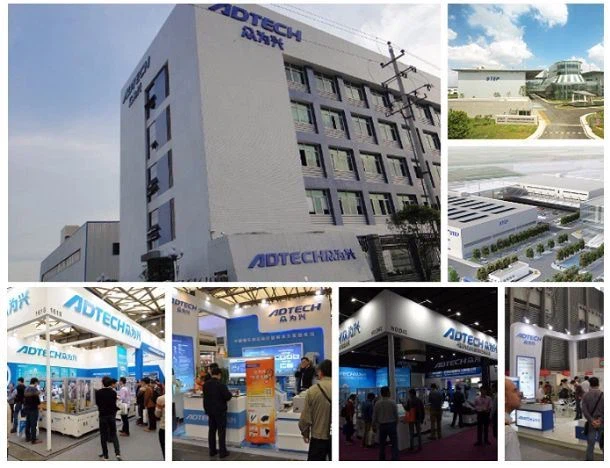
The factory is an associated company ADTECH (SHENZHEN) TECHNOLOGY CO.,LTD, located in Building B3, Pujing Guangmimng High-Tech Park, Guangming New District, Shenzhen. It occupy 7,560 square meter, has 144 employee. We have our own brand. Also accept ODM&OEM. Meanwhile, We have strict quality control measures to ensure the quality of products leaving the factory.
FAQ
Q: What is the industrial robots?
Q: What is the most popular industrial robot?
Q: What are industrial robots used for today?
Q: Do industrial robots use AI?
Q: What are the 5 most common robots?
Q: What is the oldest industrial robot?
And in 1961, the two Americans established Unimation Inc., a venture company specializing in industrial robot development. In the following year, they succeeded in the trial production of the world's first industrial robot, the Unimate.
Q: How are industrial robots controlled?
Q: What will industrial robots do in the future?
Due to the exciting advancements in Manufacturing robotics, the industry is on the cusp of a total production revolution. Robots can adapt and produce a wide variety of products more efficiently, backed by artificial intelligence (AI) and automation technology.
Q: How do industrial robots help humans?
Q: Are all robots considered AI?
Q: What robot did Elon Musk invent?
Q: What robot do we use everyday?
Q: What are the 3 rules of AI?
Q: What jobs will robots take over by 2025?
Q: What will robots do in 10 years?
Q: Which country is number 1 in robotics?
Q: What is the world's largest working robot?
Q: What is the manipulator of an industrial robot?
Q: Who invented robots?
The first industrial robots were developed by George Devol, American inventor and founder of the first robotics company in history: Unimation.
Q: Why is everyone worried about AI?
One of the most commonly cited risks is that AI will get out of its creator's control. Artificial general intelligence (AGI) refers to AI that is as smart or smarter than humans at a broad range of tasks. Current AI systems are not sentient but they are created to be humanlike.
As one of the most professional industrial robot manufacturers and suppliers in China, we're featured by quality products and good service. Please rest assured to buy customized industrial robot at competitive price from our factory.