


overview
EtherCAT is an Ethernet-based fieldbus system with an open architecture. The CAT in EtherCAT is an acronym for Control Automation Technology. Originally developed by Beckhoff Automation GmbH in Germany. EtherCAT sets a new standard for real-time performance and topological flexibility, while also complying with or even reducing the cost of fieldbus usage. EtherCAT also features high-precision device synchronization, optional cable redundancy, and the Functional Security Protocol (SIL3).
principle
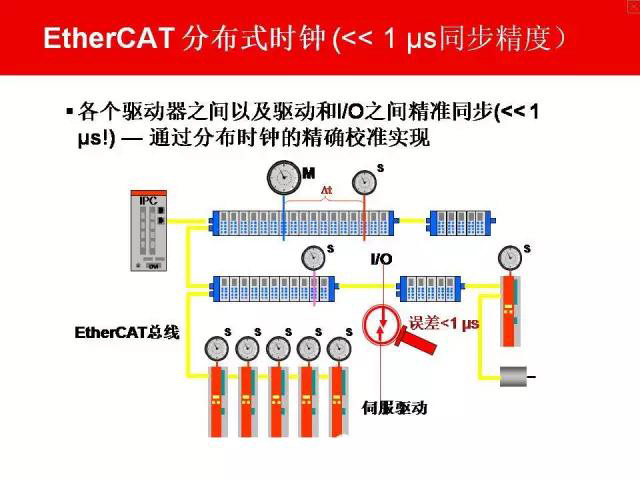
There are several Ethernet solutions to provide real-time functionality: for example, disabling the CSMA/CD access process through a higher protocol layer and replacing it with a time slice or polling procedure. Other schemes use private switches and distribute Ethernet packets with precise time control. Although these solutions can deliver packets to connected Ethernet nodes relatively quickly and accurately, bandwidth utilization is low, especially for typical automation devices, because even for very small amounts of data, a full Ethernet frame must be sent. Furthermore, the time required to redirect to the output or drive controller and to read the input data depends largely on the execution mode. It is often necessary to use a subbus, especially in modular I/O systems, which, like the Beckhoff K-bus, speed up transmission through a synchronous bus system, but such synchronization will not avoid delays in communication bus transmission.
With EtherCAT, Beckhoff was able to overcome these system limitations of other Ethernet solutions: it was no longer necessary to receive Ethernet packets at each connection point, decode them, and copy them into process data. As frames pass through each device, including the underlying terminal device, EtherCAT reads data from the station controller that is important to that device. Similarly, input data can be inserted into a message as it passes through. After the frame has been passed (delayed by only a few bits), the slave station recognizes the relevant command and processes it. This process is implemented through hardware in the slave controller and is therefore independent of the real-time running system or processor performance of the protocol stack software. The last EtherCAT slave in the network segment returns a fully processed message so that the message is returned as a response message from the first slave to the master.
From an Ethernet perspective, the EtherCAT bus segment is simply a large Ethernet device that receives and sends Ethernet frames. However, this "device" does not contain a single Ethernet controller with a downstream microprocessor, but only a large number of EtherCAT slave stations. As with any Ethernet, EtherCAT does not require a switch to establish communication, resulting in a pure EtherCAT system.
performance
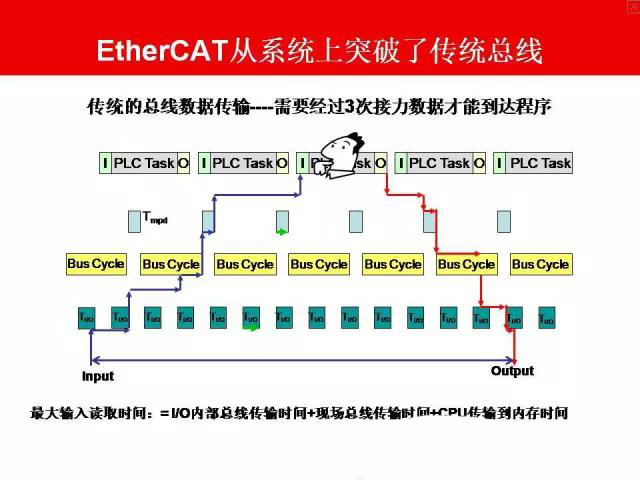
EtherCAT reaches a new level of network performance. The refresh period of 1000 distributed I/O data is only 30μs, including terminal cycle time. Through an Ethernet frame, up to 1486 bytes of process data can be exchanged, equivalent to almost 12,000 digital volumes of I/O. This amount of data can be transmitted in just 300μs.
Communication with 100 servo shafts is only 100μs. During this time, setting values and control data can be provided to all axes and their actual position and status can be reported. Distributed clock technology ensures that the synchronization time deviation between these axes is less than 1 microsecond.
With the excellent performance of EtherCAT technology, we can realize the control method which cannot be realized by the traditional fieldbus system. In this way, ultra-high speed control loops can also be formed through the bus. Functions that previously required native dedicated hardware support can now be mapped in software. The huge bandwidth resources enable state data to be transmitted in parallel with any data. EtherCAT technology enables communications technology to match modern, high-performance industrial PCS. The bus system is no longer a bottleneck to control ideas. Data delivery in distributed I/O exceeds performance that can only be achieved by local I/O interfaces.
This network performance advantage is evident in small controllers with relatively moderate computing power. EtherCAT's high-speed loop, which can be done between two control loops. Therefore, the controller always has the latest input data available and the output addressing delay is minimal. The controller's response behavior can be improved significantly without enhancing its own computing power.
EtherCAT's principles are scalable and not limited to 100 megabits of bandwidth - it is possible to scale up to gigabit Ethernet.
EtherCAT replaces PCI:
With the acceleration of the development of PC component miniaturization, the volume of industrial PC mainly depends on the number of slots required.
The use of high-speed Ethernet bandwidth and EtherCAT communications hardware (EtherCAT slave controller) data bandwidth opened up a new application possibility: interfaces normally located in IPC were transferred to intelligent interface terminals in EtherCAT systems. In addition to distributed I/O, axes, and control units, complex systems such as fieldbus master stations, high-speed serial interfaces, gateways, and other communication interfaces can be addressed through an Ethernet port on the PC. Even other Ethernet devices with no protocol variant restrictions can be connected through the DVS terminals. Industrial PC mainframe size is getting smaller, the cost is getting lower, an Ethernet interface is enough to deal with all the communication tasks.
Use Ethernet instead of PCI fieldbus devices (PROFIBUS, CANopen, DeviceNet, AS-i, etc.) for integration via distributed fieldbus master terminal. Not using fieldbus master saves PCI slots in the PC.
Bus topology
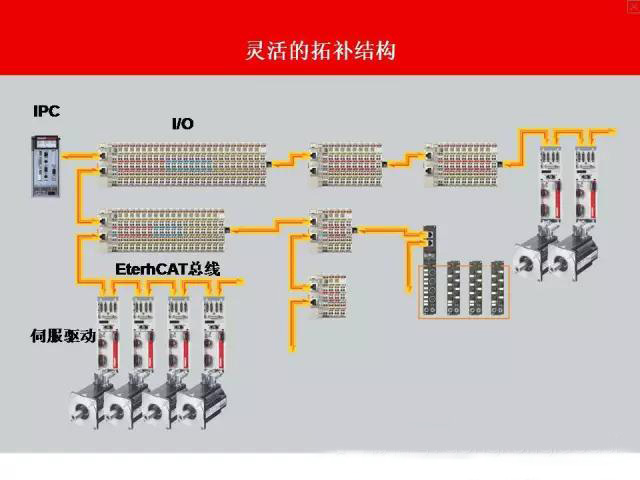
Bus, tree, or star: EtherCAT supports almost all topologies. Thus, the bus structure derived from fieldbuses can also be used for Ethernet. The combination of bus and branch structures is especially helpful for system wiring. All interfaces are located on couplers, eliminating the need for additional switches. Of course, you can also use the traditional switch-based star Ethernet topology.
The use of different transmission cables can maximize the flexibility of the wiring. Flexible and inexpensive standard Ethernet plug-in cables can transmit signals via Ethernet mode (100baseTX) or via the E bus. Optical fibers (Pfos) can be used for special applications. Ethernet bandwidth (such as different optical and copper cables) can be used in conjunction with switches or media converters. The physical features of Fast Ethernet allow devices to be 100 meters apart, whereas E-bus can only be 10 meters apart. Fast Ethernet or E-bus can be selected according to distance requirements. The EtherCAT system can accommodate up to 65535 devices, so the overall network size is almost unlimited.
You can choose the topology freely. Wiring has the greatest flexibility: whether to use the switch, is the use of bus topology structure, or tree topology structure, can be any combination of choice. Automatic address allocation; You do not need to set an IP address.
openness
EtherCAT is not only fully compatible with Ethernet, but also has a unique open design feature: it can coexist with other Ethernet protocols that provide a variety of services, and all of them coexist on the same physical medium - usually with only a small impact on overall network performance. Standard Ethernet devices can be connected to an EtherCAT system through the switch terminal, which does not affect cycle times. Devices equipped with a traditional fieldbus interface can be integrated into the network through a connection to the EtherCAT fieldbus master terminal. The UDP protocol variant allows devices to be integrated into any slot interface. EtherCAT is a fully open protocol that has been recognized as an official IEC specification (IEC/PAS62407).