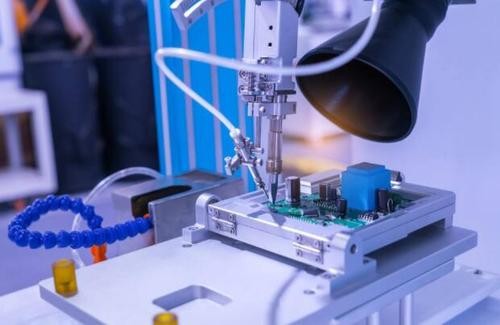
The machine vision system is composed of the following parts:
1. Camera: black and white smart camera, line scan smart camera, color smart camera, CMOS smart camera, code reader, etc.
2. Board card: black and white image acquisition card, image compression/decompression board, color acquisition card, 1394 interface board, image processing board, etc.
3. Software package: image processing software, machine vision tool software;
4. Industrial CAMERA: cmos camera, ccd color camera, area array camera, Camera-Link camera, line scan camera, infrared camera, high-speed camera, 1394 interface camera;
5. Industrial lens: camera lens, magnifying glass, high resolution lens, image scanning lens, concentrating lens, telescope, camera lens
6. Light source: led light source, xenon lighting system, UV lighting system, infrared light source, optical fiber lighting system, fluorescent lighting system;
7. Auxiliary products: calibration block, grating, ring, wiring and connector, power supply, bottom plate;
8. Image processing system: optical character, recognition system, automation/robotics technology, infrared image system;
9. Optical system: microscope, laser scanner, electronic video endoscope, industrial endoscope;
Working process of machine vision system:
1. The workpiece positioning detector detects that the object has moved close to the center of the field of view of the camera system, and sends a trigger pulse to the image acquisition part.
2. The image acquisition part sends the starting pulse to the camera and the lighting system respectively according to the pre-set procedure and delay.
3, the camera stops the current scan and starts a new frame scan, or the camera is in a waiting state before the start pulse arrives and starts a frame scan after the start pulse arrives.
4. Open the exposure mechanism before the camera starts a new frame scanning, and the exposure time can be set in advance.
5. Another start pulse turns on the light illumination, and the light opening time should match the exposure time of the camera.
6, after the camera exposure, the scanning and output of an image frame is officially started.
7, the image acquisition part receives the analog video signal through A/D to digitize it, or directly receives the digital video data after the camera is digitized.
8. The image acquisition part stores the digital image in the memory of the processor or computer.
9. The processor processes, analyzes and recognizes the image to obtain the measurement results or logical control values.
10. Process the results to control the action of the pipeline, perform positioning, correct the error of the motion, etc.