


Industrial robot development ushered in a golden age
In terms of industrial trend, the compound annual growth rate has exceeded 20% in the past 13 years. Rising labor costs and policy guidance are promoting the development of industrial robot industry. From the perspective of capital environment, financing events occurred frequently in the industrial robot field in 2017 and 18th. In the industry application, the judgment 3C field will usher in a round of outbreak.
1. Industry trend
As shown in the figure below, the sales volume of Chinese robots has been growing rapidly since 2013, with an annual compound growth rate of more than 20%. In 2018, it is predicted that more than 140,000 units will be shipped. If the average price is 200,000 yuan, the market size of industrial robots alone will reach 28 billion yuan.
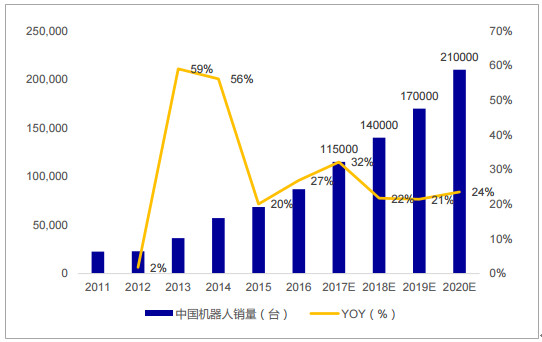
Data source: 2018-2024 In-depth Market Survey and Future Development Trend Report of China's Industrial Robot Industry released by Zhiyan Consulting
2. Driving factors
Rising labor cost: With the disappearance of demographic dividend and the pursuit of comfortable working environment in the 1980s and 1990s, the labor cost of manufacturing industry keeps increasing. The National Bureau of Statistics released the annual average salary of employees by position in enterprises above designated size in 2017. According to the report, the average wage of manufacturing industry in China is 58,049 yuan, which has lost its labor cost advantage compared with Southeast Asia. So the rising cost of labor forces the development of industrial robots.
Policy guidance: The national level has successively promulgated policies such as "Made in China 2025", "Robot Industry Development Plan (2016-2020)", "Industrial strong base Project", and so on. It is planned that by 2020, China's industrial robot density target is 150 units/person, with domestic output of 200,000 units and independent output of 100,000 units. The national will to promote the development of industrial robot industry.
3. Capital phenomenon: Capital pays more and more attention to industrial robots belonging to the production and manufacturing industry
Data show that there were 166 financing events in 2017, and 153 financing events in 2018 by the beginning of November, with the maximum amount of financing reaching hundreds of millions of yuan. The participating institutions include Sunwei, China Merchants Capital, Deutsche Union Capital, Ming Power Capital and other Chinese star investment institutions.
The use of industrial robots in 3C is a small explosion
3C products, including shell, glass, cover and other parts manufacturing technology as well as the whole machine assembly technology, its process and equipment is mature, the processing content of high repetition, high labor intensity, in line with the characteristics of automatic transformation. But the status quo in our country is that the degree of automation is still in low level. For example: at present, the density of robots in the 3C industry in China is only 11 units per 10,000 employees, while the density of robots in Japan and South Korea has already exceeded 1200 units per 10,000 employees. Market capacity growth trend is obvious. According to the results released by "grassroots research", the comprehensive level of back-end assembly, testing and packaging is less than 15% at present, and the automation rate still has great room for improvement, and will become the focus of major enterprises in the next few years.
In terms of the market scale, 3C industry is second only to automobile industry as a large market. Our country is a large country in 3C manufacturing. About 70% of the world's electronic products are manufactured and assembled by China. In contrast, the automobile industry is relatively mature, the incremental space is limited, and is basically monopolized by four big families.
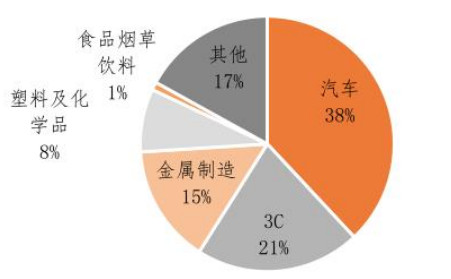
Data source: Foresight Technology Research Institute
Industry challenge/judgment
First, core parts occupy 70% of the cost of the ontology, but rely heavily on imports
From the perspective of cost structure, industrial robot is composed of control system, drive system and actuator, corresponding to controller, servo motor and reducer and other core parts. In terms of cost, core parts account for the majority of the cost of industrial robots, about 72%. For the same core parts, domestic manufacturers will buy speed reducer at nearly 4 times the price and servo drive at nearly 2 times the price. Among them, the motor and reducer are heavily dependent on imports, and the controller field is gradually localized.
Domestic servo motor market: the top three Panasonic, Mitsubishi, Yaskawa are Japanese brands, the total share reached 45%, Siemens, Bosch, Schneider and other European brands occupy high-end, the overall market share of about 30%, the overall share of domestic enterprises is less than 10%;
In the reducer market: 75% of the world's precision reducer market is occupied by Japan's Hamernacho and Nabotsk, among which Nabotsk produces RV reducer, accounting for 60% of the share, Hamernacho produces harmonic reducer, accounting for 15% of the share;
In the domestic controller market, Fanuc, Yaskawa and ABB occupy nearly 40% of the market share, while second-tier enterprises such as Epson, OTC and Staubier occupy 44% of the market share. There is a small gap between Chinese and foreign controllers. Hardware has been mastered, while domestic brands still have a gap in stability, response speed and ease of use in software.
Second. In the Long Tail market, ontology and integrator are integrated to form "ontology integrator".
China has concentrated industries such as automobiles and 3C, but most of them are general industries with low industrial integration.
In a decentralized market environment, customers' demands are often to improve the efficiency of welding and palletizing a single link or replace manual labor, and the requirements for understanding the field process are not high, and the integration difficulty is low. In the long tail market, the value provided by a single integrator or ontology manufacturer is low. Therefore, the combination of ontology and integrator becomes the choice of the industry and becomes "ontology integrator".
Third. Customer characteristics require high cost performance, easy deployment and easy operation
The Long Tail market is characterized by extremely fragmented customers, very low levels of application, and very price sensitive. Unique market characteristics put forward completely different product requirements for ontology vendors:
First: high cost performance
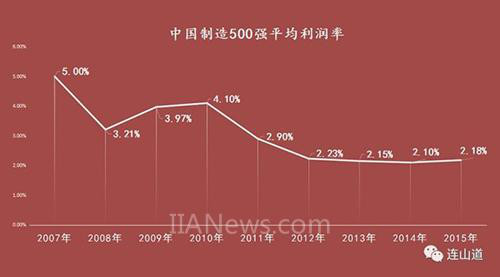
There is a big difference between China and America in manufacturing profit margin. Since 2011, the average profit margin of Chinese manufacturers has been hovering in the ultra-low profit range of 2-3% for six consecutive years. In contrast, the average profit margin of American manufacturers in the 2016 Fortune 500 is as high as 12.2%, and that of American manufacturers in the 2017 Fortune 500 is as high as 10.9%. When business owners add new industrial robot equipment under the circumstances of low profit margin, tight credit resources and high financing costs, the cost performance ratio is the key point in the key, and the core index is the equipment input back to this cycle.
Market opportunities and challenges of industrial robots
For ontology integrators, it is difficult to accept the cost of completely using imported customers for core parts, so domestic core parts replace or self-develop core parts as the choice of ontology integrators.
Second: easy to deploy
The small transformation of a single link results in the price of the customer of industrial robots not coming up, keeping in the range of hundreds of thousands to millions. However, every project needs the matching of engineer resources, which can maximize the efficiency and improve the turnover rate of engineer resources and become one of the best swords to improve the profit level. This poses a challenge to project deployment. Ease of deployment reduces deployment time and core engineer resource involvement, thereby reducing costs.
Third: easy to operate
Different from large customers in the automotive field, the staff has high cultural literacy and can have full-time personnel to participate in the early training of equipment use. Long tail customers do not have professionals who can patiently learn complex buttons and operation instructions. Fool operation is king. Easy operation of human-computer interaction link is one of the points that ontology integrators need to optimize constantly.
At present, the industrial robot industry has ushered in a golden age of development, and has also attracted the attention of many capital, among which the application of 3C field is one of the key directions worthy of attention. At present, in addition to the controller, the reducer and servo motor also received the constraints of four families. For the long-tail market except automobile and 3C, ontology and integrator gradually have no boundary and become an integrated "ontology integrator". Ontology integrators' self-research ability, easy deployment and easy operation of core components have become key factors for the success of the Long Tail market.