Top 10 Important Facts and Trends in the field of Motor Control:
01
Integration is capturing the motor control market due to technological advancements. Brushless DC motors (BLDC) and permanent magnet synchronous motors (PMSM) of various sizes and power densities are rapidly replacing motor topologies such as brushless AC/DC and AC induction.
02
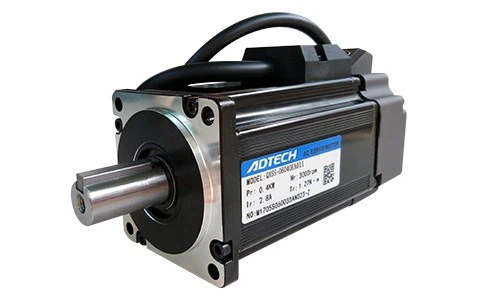
Brushless DC motors/permanent magnet synchronous motors have the same structure mechanically, except for the stator winding. Their stator windings are of different geometry. The stator is always opposite the motor magnet. These motors offer high torque at low speeds, making them ideal for servo motor applications.
03
Brushless DC motors and permanent magnet synchronous motors do not need brushes and commutators to drive the motor, so they are more efficient and reliable than brush motors.
04
Brushless DC motors and permanent magnet synchronous motors use software control algorithms instead of brushes and mechanical commutators to drive the motors.
05
The mechanical structure of brushless DC motor and permanent magnet synchronous motor is very simple. There is an electromagnetic winding on the non-rotating stator of the motor. The rotor is made of permanent magnet system. The stator can be inside or outside and is always on the opposite side of the magnet. But the stator is always a fixed part, and the rotor is always a moving (rotating) part.
06
Brushless DC motors can have 1, 2, 3, 4 or 5 phases. They may have different names and driving algorithms, but they are all essentially brushless.
07
Some brushless DC motors have sensors that help to obtain rotor position. Software control algorithms use these sensors (Hall sensors or encoders) to assist motor reversing or motor rotation. These brushless DC motors with sensors are needed when applications require start-up at high loads.
08
If the brushless DC motor does not have a sensor for obtaining the rotor position, a mathematical model is used. These mathematical models represent sensorless algorithms. In the sensorless algorithm, the motor is the sensor.
09
Brushless DC motors and permanent magnet synchronous motors have some important system advantages over brushless motors. They are able to drive motors using electronic commutation schemes, which can lead to energy efficiency improvements of 20 to 30 percent.
10
Many products today require variable motor speeds. These motors require pulse width modulation (PWM) to change the motor speed. Pulse width modulation provides precise control of motor speed and torque, enabling variable speed.