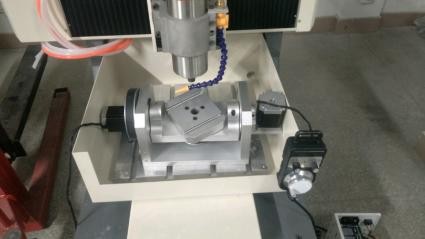
Five-axis machine tools can be divided into five-axis linkage machine tools and five-axis positioning machine tools according to whether they support linkage rotation. The difference between the two is that the latter can only meet the requirements of 3+2, while the former can complete both linked and non-linked machining tasks. The orientation of the tool axis or workpiece is fixed and does not change during the machining process.
Multi-axis machining means that at least one rotating axis is involved in the movement during the machining process, as opposed to fixed axis machining. However, it should be noted that the participation of the rotating axis in the movement does not necessarily mean that the rotating axis is linked with the translational axis. In many cases, the rotating axis serves as a positioning role. This type of machining is the 3+2 machining mentioned above, which mainly targets most mechanical parts such as automobile gearbox body, engine housing, etc.
In a three-axis milling program, the two rotating axes of the five-axis machine tool are used to fix the cutting tool in a tilted position. The name 3+2 machining technology comes from this, which is also called positioning five-axis machine tools. The fourth and fifth axes are used to determine the direction of the tool at a fixed position rather than a continuous 3+2 positioning machining principle during the machining process. Simply put, the realization of the three-axis function at a certain angle, that is, positioning, is used for machining. In short, after the machine tool has rotated at a certain angle, it still performs the machining in the same way as a normal three-axis machine tool.